
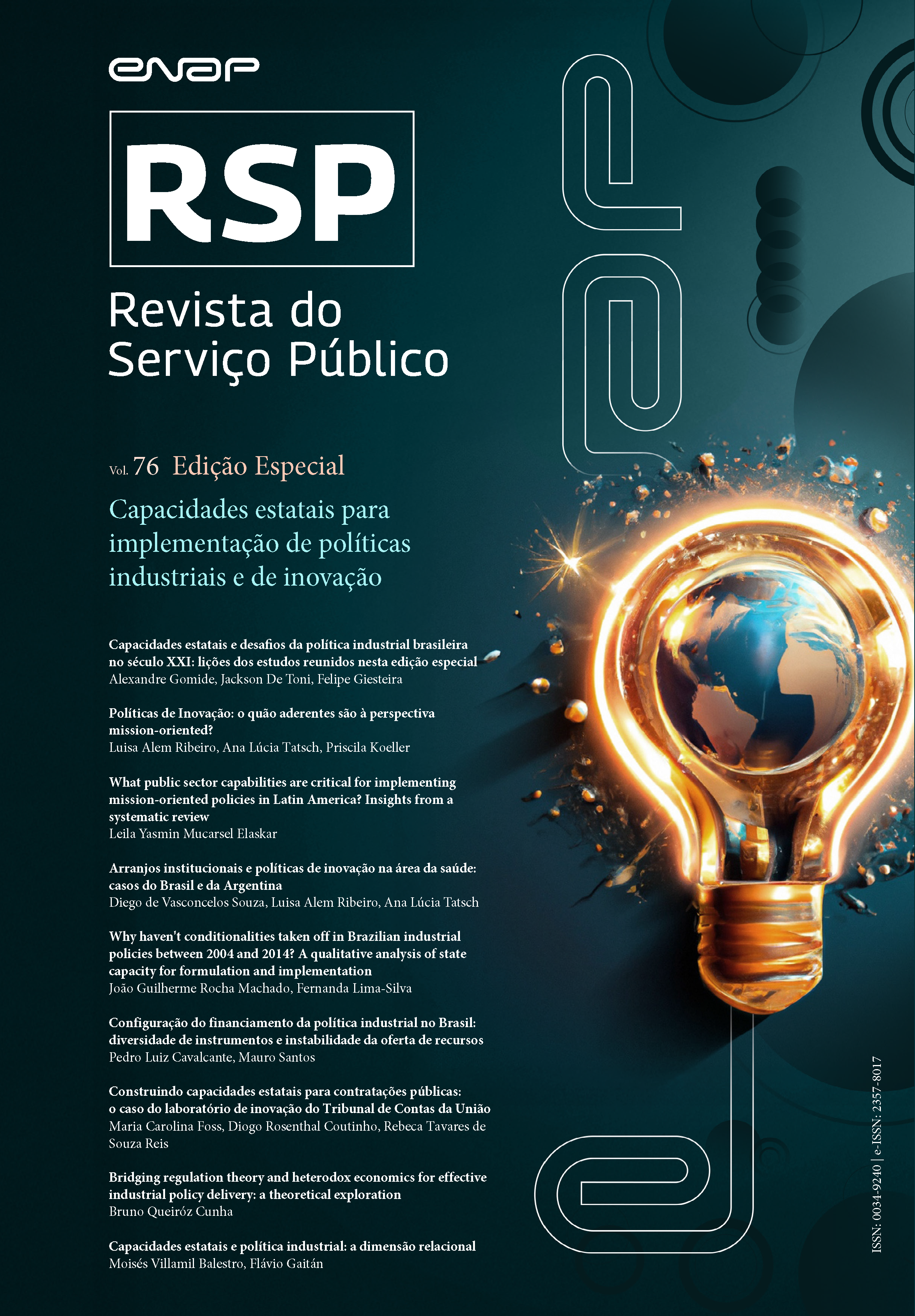
What public sector capabilities are critical for implementing mission-oriented policies in Latin America?
Insights from a systematic review
DOI:
https://doi.org/10.21874/rsp.v76ia.10762Palavras-chave:
mission-oriented innovation, dynamic capabilities, public sector, government, Latin AmericaResumo
Mission-Oriented Innovation Policies (MOIPs) have emerged as one of the most influential modalities in the field of industrial and science, technology and innovation policies in the last decade. It is a revival of the Technological Missions approach initially implemented by the central countries in the post-war period. Today, a new generation of these policies is focused on addressing Grand Societal Challenges, placing issues such as mass youth unemployment, the crisis in public health systems and climate change at the center.
In this context, developing countries are the most affected by these challenges, so MOIPs appear as a promising path towards systemic policies, more strategic and oriented to critical development problems (Mazzucato & Penna, 2016). They also show potential in terms of overcoming the usual problems for policy coordination. But the fact that most of the experiences and studies linked to MOIPs come from developed countries presents the usual risks of emulating policies from other contexts (Karo & Kattel, 2010). In this framework, the research question that motivates this paper is: What state capacities are needed to effectively implement MOIPs in the Global South, with emphasis on the experience of middle-income countries in Latin America.
Downloads
Referências
Bergek, A., Hellsmark, H., & Karltorp, K. (2023). Directionality challenges for transformative innovation policy: Lessons from implementing climate goals in the process industry. Industry and Innovation. Scopus. <https://doi.org/10.1080/13662716.2022.2163882>.
Bernazza, C. A., Comotto, S., & Longo, G. (2015). Evaluando “en clave pública”: Indicadores e instrumentos para la medición de capacidades estatales. Revista Estado y Políticas Públicas No 4. Año 2015. ISSN 2310-550X, pp. 17-36.
Bernazza, C., & Longo, G. (2014). Debates sobre capacidades estatales en la Argentina. Un estado del arte. Revista Estado y Políticas Públicas, 2(3), 107–130.
Bertranou, J. (2015). Capacidad estatal: Revisión del concepto y algunos ejes de análisis y debate. Estado y Políticas Públicas (4), 37-59
Boorman, C., Jackson, B., & Burkett, I. (2023). SDG localization: Mobilizing the Potential of place leadership through collective impact and mission-oriented innovation methodologies. Journal of Change Management, 23(1), 53–71. <https://doi.org/10.1080/14697017.2023.2167226>.
Bortz, G. M., & Gázquez, A. (2020). Políticas CTI en Argentina durante la pandemia:¿ Oportunidad para nuevas redes participativas en I+ D+ i? ri.conicet.gov.ar. <https://ri.conicet.gov.ar/handle/11336/118995>.
Bravo-Biosca, A. (2020). Experimental Innovation Policy. En Innovation Policy and the Economy v. 20, pp.191–232. <https://doi.org/10.1086/705644>.
Brown, R. (2021). Mission-oriented or mission adrift? A critical examination of mission-oriented innovation policies. European Planning Studies, 29(4), 739–761. <https://doi.org/10.1080/09654313.2020.1779189>.
Bugge, M., Berg, R., & Tømte, C. (2023). Transformative innovation policies detached from existing systems of innovation in the global south. Innovation and Development, pp. 1–24. <https://doi.org/10.1080/2157930X.2023.2215628>.
Carrizo, E. (2019). Políticas orientadas a misiones: ¿Son posibles en la Argentina? Ciencia, Tecnología y Política, 2(3), 027. <https://doi.org/10.24215/26183188e027>
Castro, A. C. (2018, marzo). Rethinking the role of the State in research platforms (Knowledge Networks and Markets – KNM the INCTs – National Institutes of Science and Technology) in Rio de Janeiro. International Conference Rethinking the state in globalized capitalism, Brazil.
Completa, E. R. (2017). Capacidad estatal: ¿Qué tipo de capacidades y para qué tipo de Estado? POSTData: Revista de Reflexión y Análisis Político, 22(1), 111–140.
Corrêa, L., & Ferraz Cário, S. A. (2022). Entrepreneurial state, mission-oriented innovation policies and renewable energy transition: Justifications, principles and evaluation. <https://seer.ufu.br/index.php/revistaeconomiaensaios/article/view/59987>.
De Graaff, S., Wanzenböck, I., & Frenken, K. (2023). The politics of directionality in innovation policy through the lens of policy process frameworks. <https://osf.io/preprints/socarxiv/au9hq/>
De Oliveira Santos, G., Penna, C. R., & Lèbre La Rovere, R. (2023). Missão Covid-19: Potenciais e limites para a construção de uma Política de Inovação Orientada a Missões. Revista Economia Ensaios, 38(1). <https://doi.org/10.14393/REE-v38n1a2023-64766>
De Toni, J. (2013). Novos arranjos institucionais na política industrial do governo LULA: A força das novas ideias e dos empreendedores políticos.
<http://repositorio2.unb.br/jspui/handle/10482/14854>.
Edquist, C., & Zabala-Iturriagagoitia, J. M. (2012). Public Procurement for Innovation as mission-oriented innovation policy. Research Policy, 41(10), 1757–1769. <https://doi.org/10.1016/j.respol.2012.04.022>.
Ferrannini, A., Barbieri, E., Biggeri, M., & Di Tommaso, M. R. (2021). Industrial policy for sustainable human development in the post-Covid19 era. World Development, 137. Scopus. <https://doi.org/10.1016/j.worlddev.2020.105215>.
Flanagan, K., Uyarra, E., & Wanzenböck, I. (2021). Towards a problem-oriented regional industrial policy: Possibilities for public intervention in framing, valuation and market creation. eprints.bbk.ac.uk. <http://eprints.bbk.ac.uk/id/eprint/43967/>.
Foray, D. (2022). The economics of incomplete plan — On conditions, procedures and design of future mission — Oriented innovation policies. Hacienda Publica Espanola, 243(4), 123–146. Scopus. <https://doi.org/10.7866/HPE-RPE.22.4.6>.
Frahm, N., Doezema, T., & ... (2021). Fixing Technology with Society: The coproduction of democratic deficits and responsible innovation at the OECD and the European Commission. Science, Technology, & …. <https://doi.org/10.1177/0162243921999100>.
Giri, L. A., Lawler, D. (2022). Política orientada por misión: ¿un instrumento viable para las políticas científicas, tecnológicas y de innovación para la Argentina? (D. Lawler, Ed.). <http://hdl.handle.net/11336/203375>.
Gonzalo, M. (2022). India from Latin America: Peripherisation, statebuilding, and demand-led growth. Routledge India.
<https://www.taylorfrancis.com/books/mono/10.4324/9781003091752/india-latin-america-manuel-gonzalo>.
Grimbert, S. F., Zabala-Iturriagagoitia, J. M., & Valovirta, V. (2024). Transformative public procurement for innovation: Ordinary, dynamic and functional capabilities. Public Management Review, pp. 1–24. <https://doi.org/10.1080/14719037.2024.2326079>.
Haddad, C. R., Nakić, V., Bergek, A., & Hellsmark, H. (2022). Transformative innovation policy: A systematic review. Environmental Innovation and Societal Transitions, 43, pp. 14–40.
Hekkert, M. P., Janssen, M. J., Wesseling, J. H., & Negro, S. O. (2020). Mission-oriented innovation systems. Environmental Innovation and Societal Transitions, 34, pp. 76–79. <https://doi.org/10.1016/j.eist.2019.11.011>.
Janssen, M., Wanzenböck, I., Fünfschilling, L., & Pontikakis, D. (2023, mayo 15). Capacities for transformative innovation in public administrations and governance systems: Evidence from pioneering policy practice. JRC Publications Repository. <https://doi.org/10.2760/220273>.
Kattel, R. (2022). Dynamic capabilities of the public sector: Towards a new synthesis. IIPP Working Paper, 2022. <https://www.ucl.ac.uk/bartlett/public-purpose/publications/2022/mar/dynamic-capabilities-public-sector-towards-new-synthesis>.
Kattel, R. (2023). Capacitações dinâmicas do setor público: Rumo a uma nova síntese. Revista do Serviço Público (Civil Service Review), 74(1).
Kattel, R., Drechsler, W., & Karo, E. (2022). How to make an entrepreneurial state: Why innovation needs bureaucracy. Yale University Press.
Kattel, R., & Mazzucato, M. (2018). Mission-oriented innovation policy and dynamic capabilities in the public sector. Oxford University Press.
Kern, F., Rogge, K. S., & Howlett, M. (2019). Policy mixes for sustainability transitions: New approaches and insights through bridging innovation and policy studies. Research Policy, 48(10), 103832. <https://doi.org/10.1016/j.respol.2019.103832>
Klerkx, L., Turner, J., & Percy, H. (2022). Navigating the rapids of agrifood systems transformation: Reflections on Aotearoa New Zealand’s emerging mission-oriented agrifood innovation system. New Zealand Economic Papers. Scopus. <https://doi.org/10.1080/00779954.2022.2158489>
Kremer, G. S. (2023). O conceito de participação em políticas de inovação orientadas por missões: 10 anos de mission oriented innovation. Anais do Congresso Internacional de Conhecimento e Inovação. <https://proceeding.ciki.ufsc.br/index.php/ciki/article/view/1508>.
Kuhlmann, S., & Rip, A. (2018). Next-generation innovation policy and grand challenges. Science and public policy, 45(4), 448–454.
Laplane, A. (2021). Market co-creating and shaping through investments in innovation: A comparative analysis of two public funding programmes in Brazil. Innovation and Development, pp. 1–22.
Laplane, A., & Mazzucato, M. (2020a). Socializing the risks and rewards of public investments: Economic, policy, and legal issues. Research Policy: X, 2, 100008.
Lindner, R., Daimer, S., Beckert, B., Heyen, N., Koehler, J., Teufel, B., Warnke, P., & Wydra, S. (2016). Addressing directionality: Orientation failure and the systems of innovation heuristic. Towards reflexive governance. Fraunhofer ISI Discussion Papers-Innovation Systems and Policy Analysis.
Lucena, R. M. (2022). Mission in Developing Countries: The Brazilian Case Through the Inova Empresa Plan.
Mayne, Q., de Jong, J., & Fernandez-Monge, F. (2020). State Capabilities for Problem-Oriented Governance. Perspectives on Public Management and Governance, 3(1), 33-44. https://doi.org/10.1093/ppmgov/gvz023
Mazzucato, M. (2024). Governing the economics of the common good: From correcting market failures to shaping collective goals. Journal of Economic Policy Reform, 27(1), 1–24. <https://doi.org/10.1080/17487870.2023.2280969>.
Mazzucato, M. (2018). Mission-oriented innovation policies: Challenges and opportunities. Industrial and Corporate Change, 27(5), 803–815. <https://doi.org/10.1093/icc/dty034>.
Mazzucato, M. (2019). Governing missions in the European Union. En Independent Expert Report.
Mazzucato, M. (2003). Transformational change in Latin America and the Caribbean: a mission-oriented approach (LC/TS.2022/150/Rev.1), Santiago, Economic Commission for Latin America and the Caribbean (ECLAC).
Mazzucato, M., & Kattel, R. (2020). COVID-19 and public-sector capacity. Oxford Review of Economic Policy. <https://academic.oup.com/oxrep/articl-abstract/36/Supplement_1/S256/5899016>.
Mazzucato, M., & Penna, C. C. R. (2020). La era de las misiones: ¿Cómo abordar los desafíos sociales mediante políticas de innovación orientadas por misiones en América Latina y el Caribe? Inter-American Development Bank. <https://doi.org/10.18235/0002828>.
Mazzucato, M., Kattel, R., Quaggiotto, G., & Begovic, M. (2021). COVID-19 and the Need for Dynamic State Capabilities: 30.
Mazzucato, M., & Rodrik, D. (2023). Industrial policy with conditionalities: A taxonomy and sample cases. <https://discovery.ucl.ac.uk/id/eprint/10196231/>.
Mucarsel, L. Y., Barile, A.C., Bhat, M. (2023). Construyendo capacidades para la innovación orientada: La respuesta argentina con perspectiva de género a la covid-19. Facultad Latinoamericana de Ciencias Sociales Ecuador; Íconos; 27; 76; 5-2023; 33-54 <http://hdl.handle.net/11336/223594>.
Normann, H. E., Svartefoss, S. M., & Thune, T. (2024). Behind the scenes: Politics and pragmatism in formulating mission-oriented innovation policies in a national context. Environmental Innovation and Societal Transitions, 52, 100891. <https://doi.org/10.1016/j.eist.2024.100891>.
Penna, C. C. R., Santos, G. de O. S., & Pereira, M. de V. G. (2021). O Papel das Agências de Inovação e Empreendedorismo na Formulação de Políticas de Inovação Orientadas a Missões: A experiência da Diretoria de Tecnologia da FAPERJ. Revista de Administração, Sociedade e Inovação, 7(2), Article 2. <https://doi.org/10.20401/rasi.7.2.449>.
Pfotenhauer, S., Laurent, B., Papageorgiou, K., & Stilgoe, J. (2022). The politics of scaling. Social Studies of Science, 52(1), 3–34. Scopus. <https://doi.org/10.1177/03063127211048945>.
Reale, F. (2021). Mission-oriented innovation policy and the challenge of urgency: Lessons from Covid-19 and beyond. Technovation, 107, 102306. <https://doi.org/10.1016/j.technovation.2021.102306>
Rikap, C. (2021). Capitalism, power and innovation: Intellectual monopoly capitalism uncovered. <https://www.routledge.com/Capitalism-Power-and-Innovation-Intellectual-Monopoly-Capitalism-Uncovered/Rikap/p/book/9780367357634>.
Sarthou, N. (2023). Las becas CONICET para temas estratégicos: Balance y desafíos. <http://sedici.unlp.edu.ar/handle/10915/156158>.
Schot, J., & Steinmueller, W. E. (2018). New directions for innovation studies: Missions and transformations. Research Policy, 47(9), 1583–1584. <https://doi.org/10.1016/j.respol.2018.08.014>.
Surtayeva, S. (2019). Políticas tecnológicas de frontera y orientadas a misiones: El caso de la nanotecnología y los satélites geoestacionarios en Argentina.
Surtayeva, S. (2021). Política tecnológica en Argentina: Los Fondos Argentinos Sectoriales en el caso de la nanotecnología. <http://sedici.unlp.edu.ar/handle/10915/122037>.
Teece, D. (2022). Evolutionary economics, routines, and dynamic capabilities. UCL Institute for Innovation and Public Purpose. Octubre 25. <https://www.ucl.ac.uk/bartlett/public-purpose/publications/2022/oct/evolutionary-economics-routines-and-dynamic-capabilities>.
Wanzenböck, I., & Frenken, K. (2020). The subsidiarity principle in innovation policy for societal challenges. Global Transitions, 2, pp. 51–59.
Wanzenböck, I., Wesseling, J. H., Frenken, K., Hekkert, M. P., & Weber, K. M. (2020). A framework for mission-oriented innovation policy: Alternative pathways through the problem–solution space. Science and Public Policy, 47(4), 474–489. <https://doi.org/10.1093/scipol/scaa027>.
Weinberg, G. M. L., Jorge, M. J., & Jorge, M. F. (2009). Produção de conhecimento e busca de aplicações: A experiência da universidade com a indústria química. História, Ciências, Saúde-Manguinhos, 16, pp. 747–761. <https://doi.org/10.1590/S0104-59702009000300011>.
Wittmann, F., Hufnagl, M., Lindner, R., Roth, F., & Edler, J. (2021). Governing varieties of mission-oriented innovation policies: A new typology. Science and Public Policy, 48(5), 727–738. Scopus. <https://doi.org/10.1093/scipol/scab044>.
.
Downloads
Publicado
Edição
Seção
Licença
Copyright (c) 2025 Revista do Serviço Público

Este trabalho está licenciado sob uma licença Creative Commons Attribution-NonCommercial-ShareAlike 4.0 International License.
- A RSP adota a licença Creative Commons (CC) do tipo Atribuição – Uso Não-Comercial (BY-NC).
- A licença permite que outros remixem, adaptem e criem obra licenciada, sendo proibido o uso com fins comerciais.
- As novas obras devem fazer referência ao autor nos créditos e não podem ser usadas com fins comerciais, porém não precisam ser licenciadas sob os mesmos termos dessa licença.
- Ao publicar o artigo na RSP, o autor cede e transfere para a ENAP os direitos autorais patrimoniais referentes ao artigo.
- O artigo publicado na RSP não poderá ser divulgado em outro meio sem a devida referência à publicação de origem.
- O autor que tiver o artigo publicado na RSP deverá assinar o Termo de Concessão de Direitos Autorais (em momento oportuno a editoria da Revista entrará em contato com o autor para assinatura do Termo).