
Capacidades estatales y política industrial
la dimensión relacional
DOI:
https://doi.org/10.21874/rsp.v76ia.10890Palabras clave:
capacidades estatales, política industrial, coalición, misiónResumen
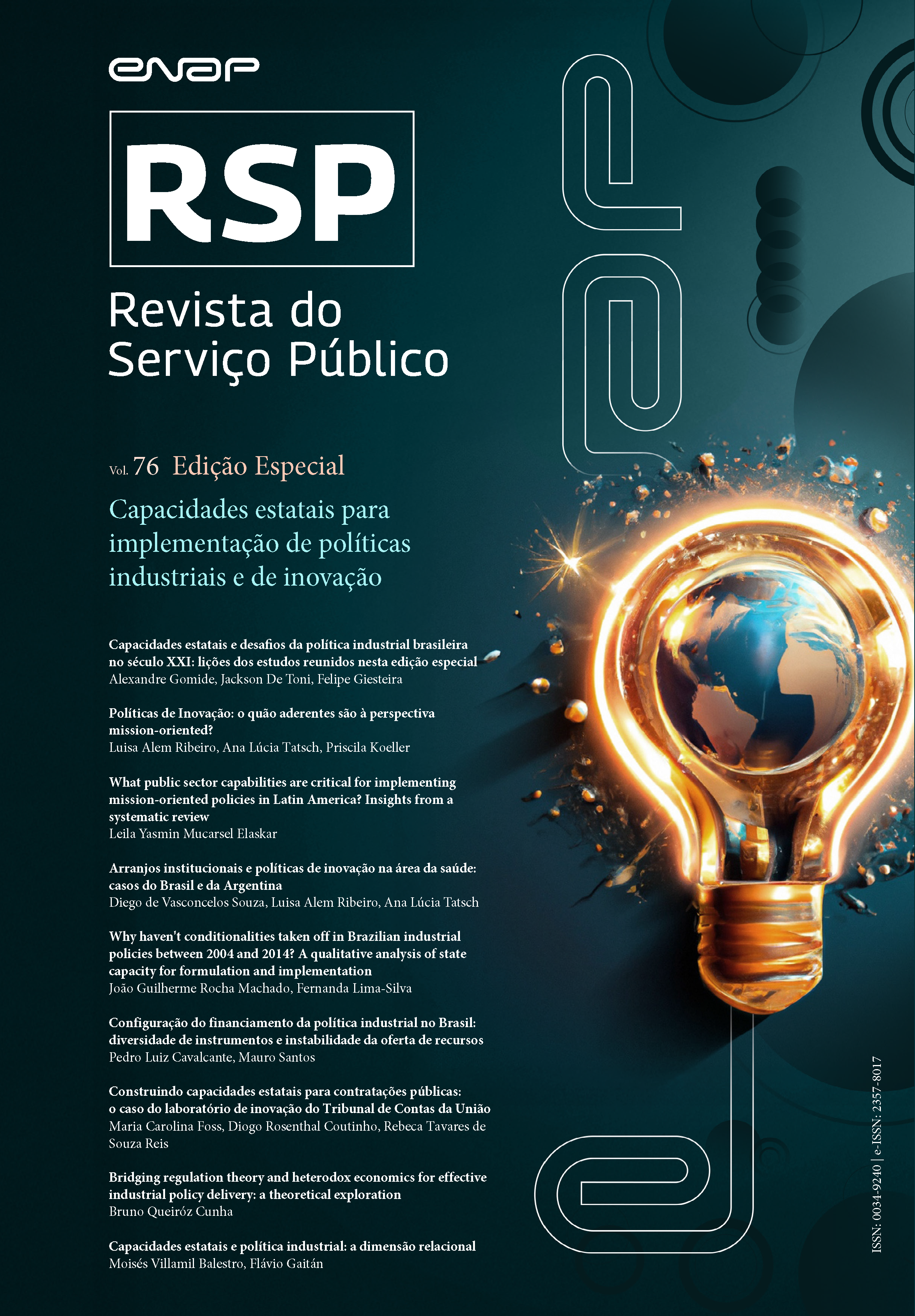
This article explores the political dimension of the relationship between state capacities and industrial policy. The analysis of the recent experience of industrial policy in Brazil has made it possible to understand the relational element of state capacities. For industrial policy to occupy the necessary centrality and legitimacy with a time horizon beyond electoral cycles, it requires societal recognition capable of putting political pressure on the executive and legislative branches. Giving visibility and building consensus around industrial development is an integral part of the politics of state capacities. The context of resuming industrial policy faces a much more complex political, social, economic, and environmental environment than in the first decade of the 21st century. The aspiration of broader neo-industrialization is to enable the country to break out of the middle-income trap. To this end, the vision of the future or fictional expectations (Beckert,2016) constitutes an impetus in the relationship between industrial policy and state capacities. Two Gordian knots that require an aggiornamento of state capacities are the relational dimension with political, social, and economic actors who must take up the societal, political, and transformational potential aspects of industrial policy in economic development.
Descargas
Citas
ANDREONI, A; CHANG, H-J. The political economy of industrial policy: Structural interdependencies, policy alignment and conflict management. Structural Change and Economic Dynamics, v. 48, p. 136–150, 2019. https://doi.org/10.1016/j.strueco.2018.10.007
ARBIX, G.; MIRANDA, Z.; TOLEDO, D.; ZANCUL, E. Made in China 2025 e Industrie 4.0: A difícil transição chinesa do catching up à economia puxada pela inovação. Tempo Social, v. 30, n .3, 2018. https://doi.org/10.11606/0103-2070.ts.2018.144303
BAGCHI, A. K. The Developmental State in History and in the Twentieth Century, Regency Publications, New Delhi, 2004
BECKERT, J. Imagined futures: fictional expectations and capitalist dynamics, Cambridge, Harvard University Press, 2016.
BOCEK, F. Ersatz capitalism and industrial policy in Southeast Asia: a comparative institutional analysis of Indonesia and Malaysia, New York, Routledge, 2022.
BOSCHI, R.; GAITÁN, F. Capacidades estatais, ação pública e desenvolvimento. Mimeo, 2024.
BOUDON, R. The unintended consequences of social action, London, Macmillan Press, 1982.
BRESSER-PEREIRA, L. C. Em busca do desenvolvimento perdido: um projeto novo-desenvolvimentista para o Brasil, São Paulo, FGV Editora, 2018.
CHANG, H-J. Chutando a Escada, a Estratégia do Desenvolvimento em Perspectiva Histórica, São Paulo, UNESP, 2003.
CHANG, H-J.; ANDREONI, A. Industrial Policy in the 21st Century. Development and Change, v. 51, n. 2, p. 324–351, 2020. https://doi.org/10.1111/dech.12570
DI STEFANO, G; GAMBARDELLA, A; VERONA, G. ‘Technology Push and Demand Pull Perspectives in Innovation Studies: Current Findings and Future Research Directions’, Research Policy, v. 41, n. 8, p. 1283–1295, 2012. https://doi.org/10.1016/j.respol.2012.03.021
DONER, R. F. The Politics of Productivity Improvement: Quality Infrastructure and the Middle-Income Trap. Thammasat Economic Journal, v. 34, n. 1, p. 1–56, 2016. Recuperado de https://so05.tci-thaijo.org/index.php/TER/article/view/137698
DUTZ, M. A. Jobs and Growth: Brazil’s Productivity Agenda. Jobs and Growth: Brazil’s Productivity Agenda., 2018. https://doi.org/10.1596/978-1-4648-1320-7
EVANS, P.; RAUCH, J. E. Bureaucracy and growth: a cross-national analysis of the effects of “Weberian” state structures on economic growth. American Sociological Review, 64(5), p.748-765, 1999. https://doi.org/10.1177/000312249906400508
EVANS, P. Autonomia e parceria: estados e transformação industrial, tradução de Christina Bastos Tigre, Rio de Janeiro, Editora UFRJ, 2004.
EVANS, P. B.; HELLER, P. Human Development, state transformation and the politics of the developmental state in Leibfried, Stephan et al. (edit.) The Oxford Handbook of Transformations of the State, Oxford, Oxford University Press, 2015.
FRANCIS, S. Industrial policy challenges for India: global value chains and free trade agreements, New York, Routledge, 2019.
FUKUYAMA, F. State-building: governance and world order in the 21st century. Cornell University Press, 2004.
GEDDES, B. Politician's Dilemma: Building State Capacity in Latin America. University of California Press, 1994.
GOMIDE, A.; SILVA, M. M. de Sá; LEOPOLDI, M. A. Desmonte e reconfiguração de políticas públicas (2016-2022), Brasília, IPEA; INCT/PPED, 2023. https://repositorio.ipea.gov.br/handle/11058/11939
HAU, Matthias V. State Theory: four analytical traditions in Leibfried, Stephan et al. (edit.) The Oxford Handbook of Transformations of the State, Oxford, Oxford University Press, 2015.
HICKEY, Sam (edit) Pockets of Effectiveness and the Politics of State-building and Development in Africa, Oxford, Oxford University Press.
KWON, H-K. Changes by Competition, Oxford, Oxford University Press., 2021.
KATTEL, R.; MAZZUCATTO, M. Mission-oriented innovation policy and dynamic capabilitites in the public sector. Industrial and Corporate Change, v. 27, n. 5, p. 787-801, 2018. https://doi.org/10.1093/icc/dty032
KATTEL, R.; DRECHSLER, W.; KARO, E. How to Make an Entrepreneurial State, New Haven, Yale University Press, 2022.
JUHÁSZ, R.; LANE, N.; RODRIK, D. The New Economics of Industrial Policy. HKS Working Paper No. RWP23-022#, 2023. Disponível em: https://ssrn.com/abstract=4542861 or http://dx.doi.org/10.2139/ssrn.4542861
LINDBLOM, C. The market as prison. The Journal of Politics, v. 44, n. 2, p. 324-336, 1982. Disponível: https://www.journals.uchicago.edu/doi/epdf/10.2307/2130588
LINDVALL, J.; TEORELL, J. State capacity as power: a conceptual framework, STANCE Working Paper Series, v. 2016, n. 1. Department of Political Science, Lund University.
MANN, M. The autonomous power of the state: Its origins, mechanisms and results. European Journal of Sociology/Archives Européennes de Sociologie, v. 25, n. 2, p. 185-213, 1984. https://doi.org/10.1017/S0003975600004239
MATTOS, C. Análise do Plano Brasil Maior, Nota Técnica de Consultoria Legislativa, Brasília, Câmara dos Deputados, 2013. Disponível em https://bit.ly/4ecLyyM. Acessado em 13 de setembro de 2024.
MAZZUCATO, M. Mission Economy, London, Penguin Books, 2021.
MONGA, C.; LIN, J. Y. Introduction: Structural Transformation—Overcoming the Curse of Destiny in Monga, Célestin e Lin, Justin Y. (edit.) The Oxford Handbook of Structural Transformation, Oxford, Oxford University Press, 2019.
OREIRO, J. L.; DE PAULA, L. F. Macroeconomia da Estagnação Brasileira, Rio de Janeiro, Alta Books, 2021.
PARRADO, E. Overcoming Political Short-Termism in Latin America, 2024. Disponível em https://bit.ly/3MTx3U8. Acesso em 25 de julho de 2024.
PAUS, E. Escaping he middle-income country. Asian Development Bank Institute, 2017. https://www.adb.org/publications/escaping-middle-income-trap-innovate-or-perish
PEREIRA, H. C. I.; MISSIO, F. J. Macroeconomia da desindustrialização e a necessidade de um projeto de desenvolvimento econômico para o Brasil. In: Araújo, Eliane; Feijó, Carmem. Industrialização e Desindustrialização no Brasil: Teorias, Evidências e Implicações de Política, Curitiba, Editora Appris,2023.
POULANTZAS, N. Political Power and Social Classes, transl. Timothy O’Hagan, London, Verso. 1978.
PRZEWORSKI, A.; WALLERSTEIN, I. Structural Dependence of the State on Capital. American Political Science Review, v. 82, n. 1, p. 11-29, 1988.
SCHNEIDER, B. R. Business Politics in Latin America: Patterns of Fragmentation and Centralization. In: Oxford Handbook of Business and Government, (eds) David Coen, Wyn Grant, and Graham Wilson, Oxford, Oxford University Press, 2010.
SCHNEIDER, B. R. Designing Industrial Policy in Latin America: Business-State Relations and the New Developmentalism, Basingstoke, Palgrave/McMillan, 2015.
SKOCPOL, T. Bringing the State Back. In: Strategies if Analysis in Current Research. In P.B. Evans, D. Rueschemeyer, T. Skocpol (Eds.) Bringing the State Back in (p. 3–43). New York: Cambridge University Press, 1985.
SCHMIDT, V. Discursive Institutionalism in Morlino, Leonardo et al. (edit.) International Encyclopedia of Political Science, Thousand Oaks, Sage Publications, 2011.
SOUZA, C. Capacidade estatal: notas sobre definição, dimensões e componentes. Brasília: Ipea, 2012. Mimeografado.
SUZIGAN, W.; GARCIA, R.; ASSIS, Feitosa, P. H. Institutions and industrial policy in Brazil after two decades: have we built the needed institutions?, Economics of Innovation and New Technology, v.29,n.7,p.799-813, 2020. https://doi.org/10.1080/10438599.2020.1719629
TREGENNA, F. Deindustrialization and premature deindustrialization. In: Erik S. Reinert, Jayati Ghosh e Rainer Kattel (ed.), Handbook of Alternative Theories of Economic Development, chapter 38, p. 710-728, 2016. Edward Elgar Publishing.
WADE, R. Governing the market: economic theory and the role of government in East Asian industrialization. Chichester: Princeton University Press, 1990.
YÜLEK, M. A. Industrial Policy and sustainable growth, Singapore, Springer, 2018.
.
Descargas
Publicado
Cómo citar
Número
Sección
Licencia
Derechos de autor 2025 Revista do Serviço Público

Esta obra está bajo una licencia internacional Creative Commons Atribución-NoComercial-CompartirIgual 4.0.
- A RSP adota a licença Creative Commons (CC) do tipo Atribuição – Uso Não-Comercial (BY-NC).
- A licença permite que outros remixem, adaptem e criem obra licenciada, sendo proibido o uso com fins comerciais.
- As novas obras devem fazer referência ao autor nos créditos e não podem ser usadas com fins comerciais, porém não precisam ser licenciadas sob os mesmos termos dessa licença.
- Ao publicar o artigo na RSP, o autor cede e transfere para a ENAP os direitos autorais patrimoniais referentes ao artigo.
- O artigo publicado na RSP não poderá ser divulgado em outro meio sem a devida referência à publicação de origem.
- O autor que tiver o artigo publicado na RSP deverá assinar o Termo de Concessão de Direitos Autorais (em momento oportuno a editoria da Revista entrará em contato com o autor para assinatura do Termo).